Why our classic massage is in a completely different league

Matej Lipták
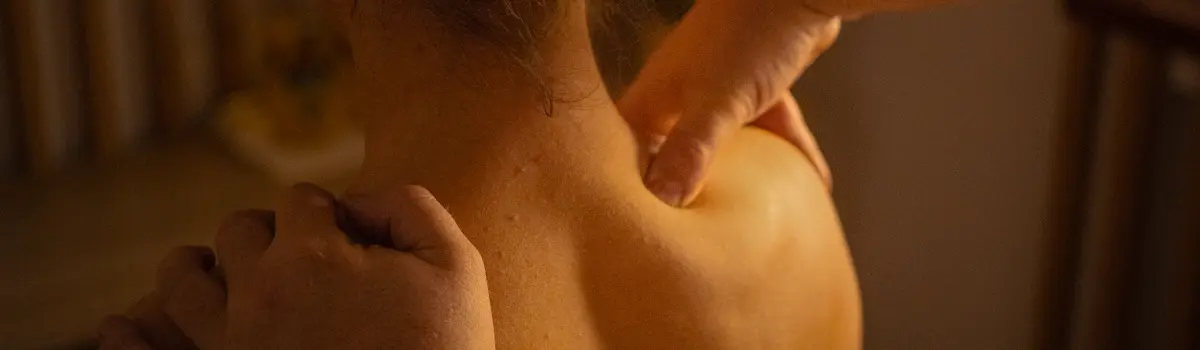
From practice that sometimes makes you laugh and sometimes takes you by surprise
From the gentleman who got "rubbed" on his back for twenty minutes at a spa, to the massage therapist at an Italian resort who watched his favourite series during the massage (yes, really!), to the lady who gossiped for an hour instead of massaging and spent 40 minutes of it on one leg. Or a massage in a hospital – with such weak pressure that you could barely feel the touch. And I must not forget the legendary massage therapist with holey socks and a smell you won't easily forget. And then there is the opposite extreme – those who literally torture you for an hour. They press and press… and when your head hurts for two days afterwards and you have bruises, apparently that's how it's supposed to be and "it will get better".
Oh dear...
You can't help asking – what happened to this beautiful, professional craft? Today anyone does massage, often without basic knowledge of the body. And often for a lot of money, with a promise of 100% effect and without humility towards doctors, psychologists or coaches.
So let's be frank about how I see it – as a trainer, massage therapist, physiotherapist… and a person who loves this job.

What actually is a classic or Swedish massage?
Classic massage existed in Egypt, Greece and ancient Rome, it appears in every third book about health and perhaps even on a fresco in some cave. It has been practised for centuries, so there must be something to it – since it has survived to this day, even though we have invented painkiller gels, chiropractic and all sorts of miracle patches (yes, that was irony).
When it is done well, it really works – and maybe that is exactly why people still want it. Classic massage has precisely described techniques:
- stroking (effleurage)
- kneading (petrissage)
- friction (frictions)
- tapping (tapotement)
- vibrations
These techniques determine the type of movement and its effect – for example warming up, releasing, increasing blood flow or activating the muscles and the nervous system. But they do not prescribe the exact order, strength or duration.
The combination of strokes, pressure, skill, technique, tempo and flow, the cosmetics used, the therapist's mood and the environment – all of this decides whether the massage will be relaxing or also therapeutic.
And this is where the turning point comes – and often the problem!
How we do classic massage
First of all, I put great emphasis on training our massage therapists. I want people with a medical education, or at least many years of practice, who have completed professional courses and seminars, to work with us.
We teach them to communicate with the client before the massage – to find out their expectations, fitness, health, age and occupation.
Because it is exactly these things that determine how long and how intensive the massage should be.
We also teach them basic diagnostics – that is, when a client is suitable for a massage at all, whether they have contraindications that could endanger them, and whether they should first be seen by a doctor or a physiotherapist. I remember a client I refused to massage and sent to the emergency room. The next day his wife called to say it was appendicitis. Pain can often be a symptom of another illness.

The body needs to be tuned for the massage
Everything matters here – from the amount of oil to its type. If there is too much of it, the therapist cannot warm up the muscle (I know, I have experienced it on my own body). Sometimes an oiled back simply cannot even be properly "grabbed", let alone a myogelosis (a stiff muscle knot) worked out.
Tempo is just as important.
If you want to relax and the therapist goes "full throttle", your nervous system will not calm down.
On the other hand, if the therapist presses too hard, instead of releasing, they only increase tension.
Every stroke, every movement – its speed, pressure and atmosphere – affects the nervous system and how the body adjusts.
These are basics that sound completely obvious, yet in most hotels, wellness centres and hospitals the practice is the opposite.
Knowledge and education are the foundation:
We keep training our massage therapists. We teach them the connections between muscles, joints, trigger points and the client's current physical and mental state – and how to combine it all into a massage that makes sense.
Examples from practice:
- Stiff neck?
- It can cause migraines, dizziness and headaches.
- But when we purposefully release the neck, find the trigger points and eliminate them, gently massage the area around the trapezius and the back of the head, and release the whole back and chest muscles, the tension eases – and often the headache with it. Repeated massage and a good physiotherapist can reduce the number of migraines this way and in some cases perhaps eliminate migraines completely.
- Spasms between the shoulder blades?
- They can radiate all the way to the chest and cause a stabbing feeling near the heart, or pain in the shoulder and arm.
- Correctly chosen pressure, work with the fascia, releasing and stretching the muscles and the rhythm of breathing help release the chest area – and the discomfort subsides.
- Knee pain?
- Sometimes it has nothing to do with the knees – but with tension in the thighs, calves or pelvis.
- Targeted work on the gluteal muscles, thigh trigger points and calves can work wonders – and the knee suddenly "breathes a sigh of relief".

And this is exactly what we teach our massage therapists to perceive and feel – to treat every client individually and not to perform the massage as a memorised routine. That is why you may come, for example, with a headache – and find out that the cause lies somewhere between stress and lifestyle, and that a relaxing approach to the massage may be exactly what helps release the muscles.
A classic that makes sense
Classic massage is a beautiful and universal technique with almost no limits.
Or better said – it has only a few limits:
unwillingness to learn, lack of interest in the work or bad character.
You will not find such massage therapists with us.
And if you happen to... let us know.
We will be grateful to you on behalf of all decent and professional massage therapists!!!

Matej Lipták Massage therapist and physiotherapist
My name is Matej and I am the founder of the Masáže Tatry brand. I make sure that all team members are qualified professionals and that the highest ethical standards are maintained. I have been practising this craft for ten years and keep improving in it. I write articles on this blog to bring the world of massage closer to you, share my experience and advice on how to choose the right massage for your needs, and help you better understand how massage contributes to overall health and well-being.